
These Rubik’s Cube flags weren’t our idea. They were the kids’.
The homeschool kids at Calvin’s Farm in Flower Mound asked a simple question: could you make a country’s flag on one face of a Rubik’s Cube? Then they asked a bigger one: could you make all of them?
The kids might not have been the first people to try making flags on a Rubik’s Cube. Cubers have been playing with patterns for years. What they did next is the part that matters: they went ahead and finished the project.
They have something most kids don’t: Ryan Pilat, Calvin’s Farm Professor of Speed Cubing, to help them with the cube. Ryan is a competitive speedcuber (WCA ID 2016PILA03) with 210 official World Cube Association competitions behind him, and he has held #1 in the world in Sum of Ranks. So they made it their project: all 196 countries, each one a best estimate built with only nine pixels.
This isn’t even the farm’s first cube lesson. Calvin already learned the 2×2 cube from Ryan.

The hard part: a flag in nine pixels
Look at the American flag. It has 50 stars, 13 stripes and three colors, and the kids had one 3×3 face to fit it on. Something has to give. So they asked what makes the flag look like the flag: a blue corner up top, red and white below. That’s the whole game. You aren’t copying the flag. You’re deciding what matters most about it.
Then the cube pushes back. The center square of each face never moves. Whatever color it is, that’s the middle of your flag. So the first decision for every flag is which face to build on. America ended up on the blue-center face, which is why blue sits in the middle as well as the corner. It’s the first rule of cube flags, and it’s a real lesson in working within limits.
What one cube teaches
- Geography: finding the country, then really looking at its flag.
- Spelling and handwriting: every flag gets its name written out by hand. Check the photos.
- Writing: explaining why you chose each square.
- Cube skills: reading notation, planning moves and undoing mistakes.
- Creativity, most of all: there’s no answer key. Two kids can build two different Turkeys and both be right.
This is what a decentralized lesson looks like. Nobody handed out a worksheet or set a bell schedule. Kids soaked up flags, maps, spelling and cube tricks from wherever they could find them, then put it all together themselves. A centralized system would have planned this as four separate subjects. The kids just did it. That’s the same idea behind Calvin’s Flower Mound homeschool philosophy and Calvin’s own Back to School Fool post.

How to read the moves
Start every flag from a solved cube with standard colors: white opposite yellow, green opposite blue and red opposite orange. Hold the cube the way each flag says, which center faces you and which is on top, and don’t turn the whole cube while you work.
- R L U D F B turn the Right, Left, Up (top), Down (bottom), Front or Back face a quarter turn clockwise, as if you were looking straight at that face.
- ‘ (say “prime”) means counterclockwise. R’ is the right face turned the other way.
- 2 means a half turn. U2 is the top face turned twice.
When you finish, the face toward you is the flag. We checked every sequence below on two separate computer cube simulators, and each one is as short as it can be using face turns.
The Nine Rubik’s Cube Flags the Kids Built
1. United States
The real flag has 50 stars on a blue field and 13 red and white stripes. With only nine squares, the kids gave the blue field the top-left corner and let red and white carry the stripes. They built it on the blue-center face, so blue sits in the middle too, because a center piece never moves.
Hold: blue center facing you, yellow center on top.
Moves (6): F U R L' F2 U'
2. Russia
Russia’s flag is three stripes, white, blue and red, top to bottom. Nine squares fit three stripes perfectly, and the blue center sits right where the blue stripe belongs.
Hold: blue center facing you, white center on top.
Moves (5): R' F U2 F2 D
3. Japan

Japan’s flag is a red circle on a white field. The kids put the red center in the middle and surrounded it with all eight white stickers on the cube.
Hold: red center facing you, white center on top.
Moves (6): F B R' L U' D'
4. Greece
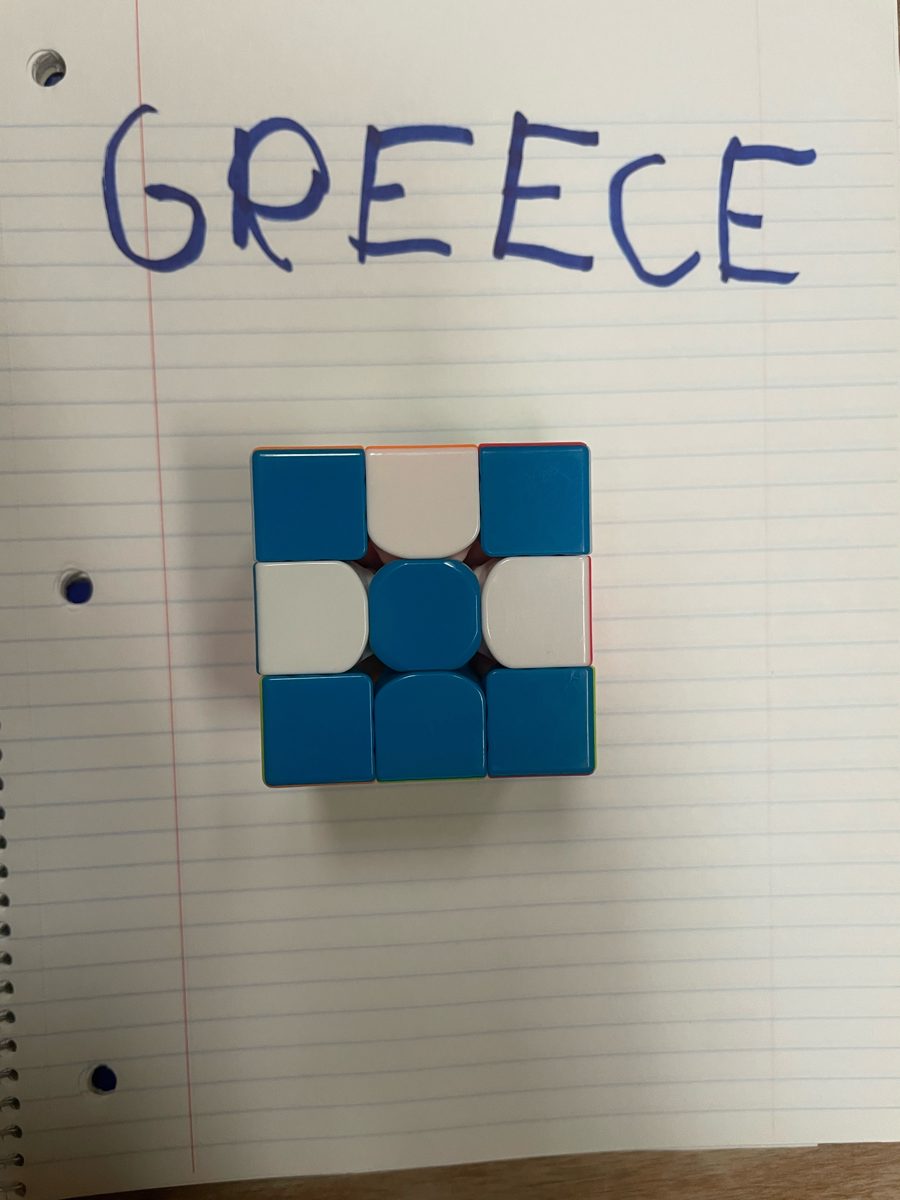
Greece’s flag has blue and white stripes and a white cross on blue in the upper-left corner. The kids alternated blue and white across the top to suggest the cross and stripes, then went solid blue along the bottom.
Hold: blue center facing you, white center on top.
Moves (7): R' U' D F' B2 R' L
5. Turkey
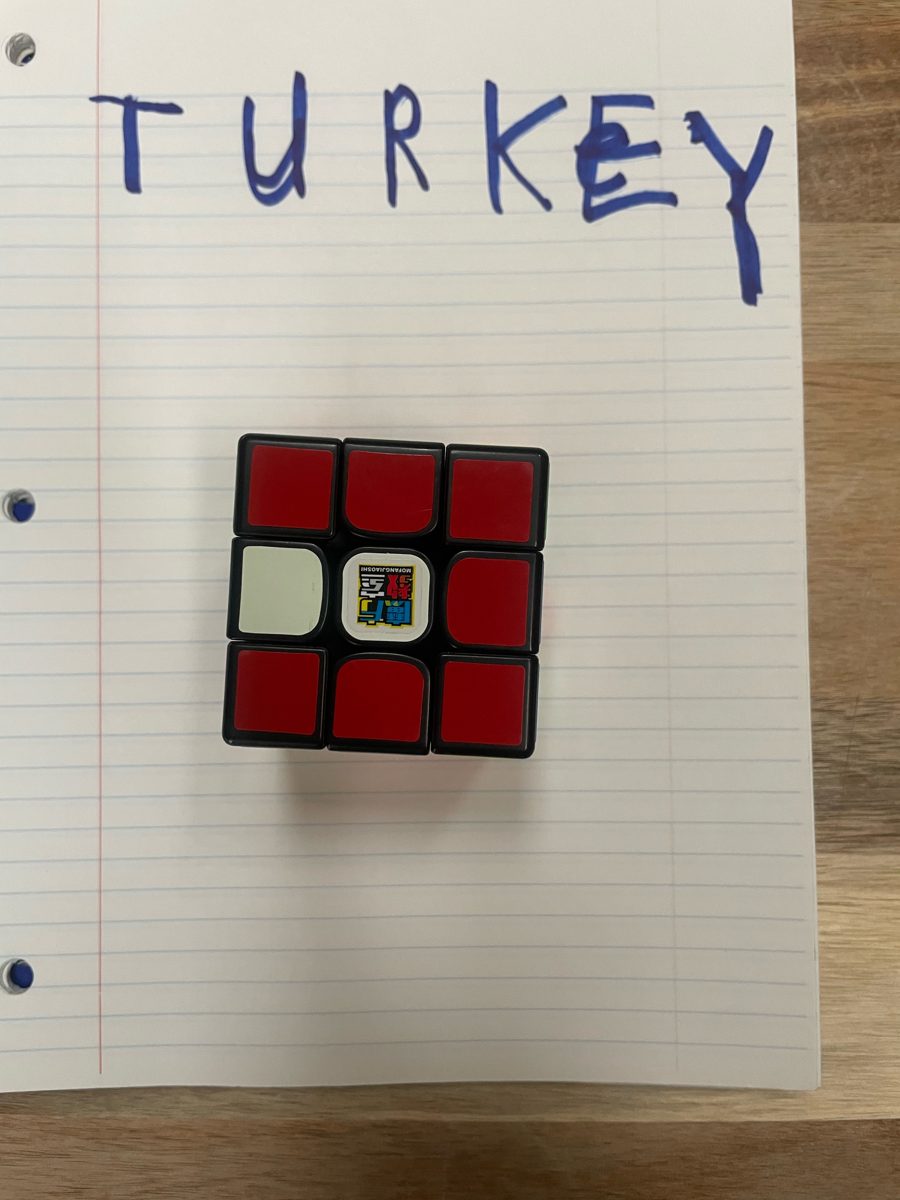
Turkey’s flag is red with a white crescent and star set toward the left. The kids used a black-plastic cube with a logo on its white center, so the white center and one white square to its left stand in for the crescent and star.
Hold: white center facing you, green center on top.
Moves (4): F U' D R'
6. Saudi Arabia
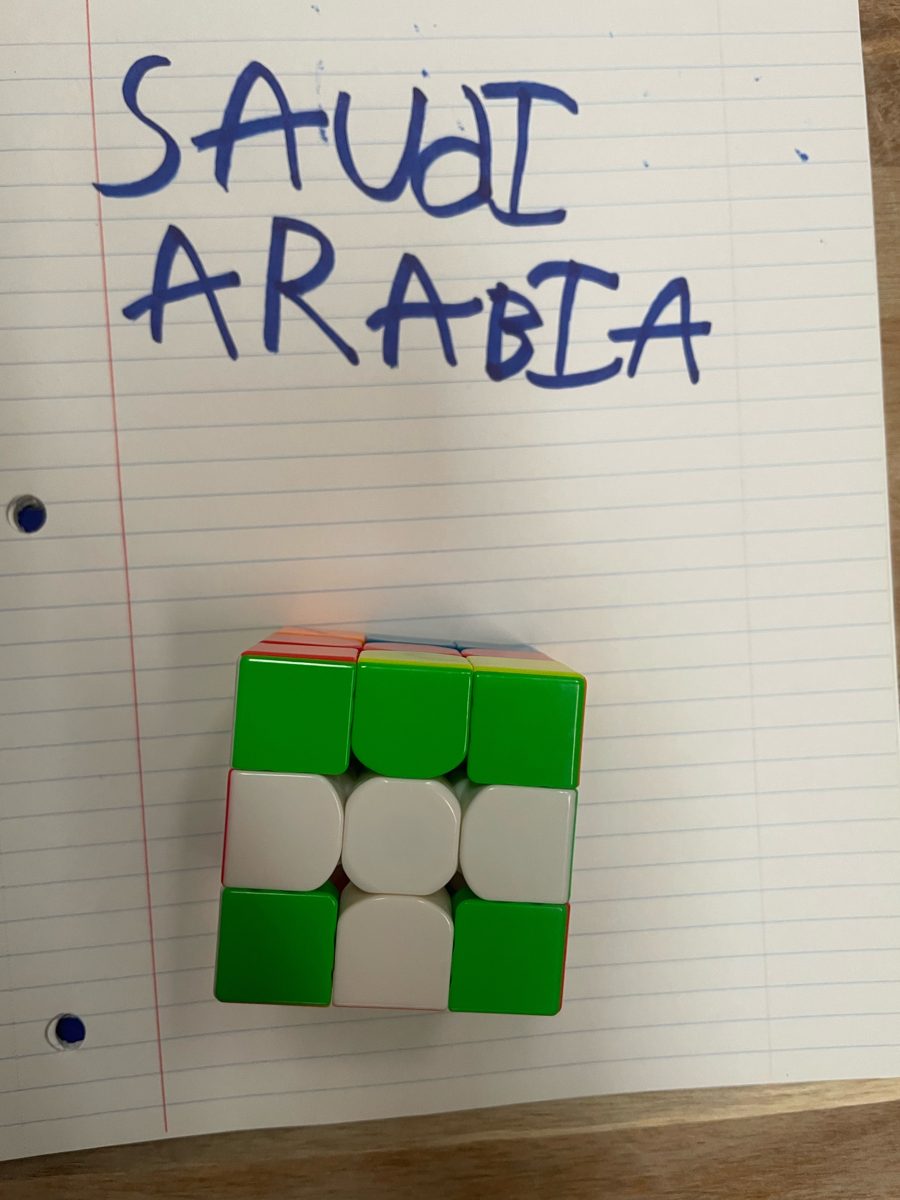
Saudi Arabia’s flag is green with a white inscription and a white sword beneath it. The kids made a white middle row for the writing and added one white square below it for the sword.
Hold: white center facing you, orange center on top.
Moves (4): D F2 B2 D'
7. Brazil

Brazil’s flag is a green field with a yellow diamond and a blue globe in the middle. Green corners, yellow edges and the blue center make that diamond in nine squares.
Hold: blue center facing you, yellow center on top.
Moves (8): R' U' L' F R U R2 L2
8. South Korea

South Korea’s flag is white with a red-and-blue circle in the middle and four black symbols around it. The cube has no black, so the kids zoomed in on the circle: red on top, blue on the bottom, with one blue square curling up on the left to suggest the swirl.
Hold: red center facing you, green center on top.
Moves (4): D R F L'
9. Argentina
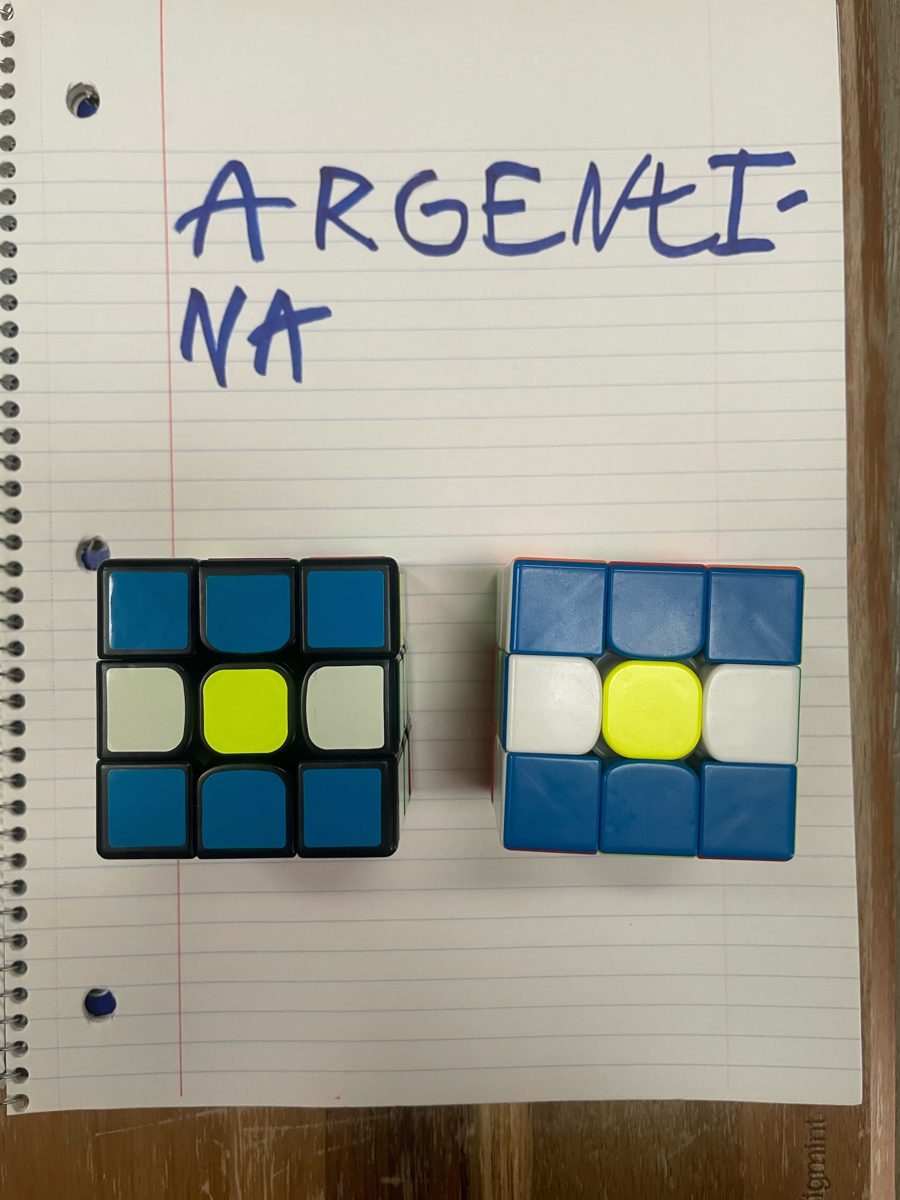
Argentina’s flag is light blue, white and light blue stripes with a golden sun in the middle. The yellow center is the sun, and the kids built it twice, once on each of two different cubes.
Hold: yellow center facing you, orange center on top.
Moves (4): R2 L2 U' D
Get all 196 flags, free
We’re turning the whole project into a printable book created by Ryan Pilat. It will have a cube design for every country’s flag, the exact moves and the reason behind each choice.
Get the free 196-flag book here, with an optional $3 or $11 tip.
Families who like a quiet creative project can also peek at Calvin’s Coloring Maze, another Calvin’s Farm homeschool download in the works.
Want your kid to cube like this?
Ryan coaches speedcubing, whether your kid is working on a first solve or ready to level up. If you want good speedcubing lessons, email Ryan to book coaching or see his Professor of Speed Cubing page.
Homeschool kids rock. Give them a cube, a map and a little room, and see what they build. If your family is around Flower Mound, start here, book a short farm tour, or come see the rest of Calvin’s Farm — including fresh Flower Mound eggs when you want them, and other farm lessons.
Created by Ryan Pilat, Calvin’s Farm Professor of Speed Cubing, with the Calvin’s Farm homeschool kids.
Calvin’s Farm runs on tips — that’s how we keep the landscaping going, care for the chickens, and share free lessons. If you’d like to leave a tip, you can do that on our Support Calvin’s Farm page.
Frequently asked questions
How do you make a country flag on a Rubik’s Cube?
You use one face of the cube, which is only nine squares. Start from a solved cube, hold it so the right color center faces you, and follow the moves in this post. The free download will cover all 196 countries the same way.
Why does the center color matter so much?
On a Rubik’s Cube, the center square of each face never moves. That color has to be the middle of your flag, so you pick the face first and design around it.
Who created this Calvin’s Farm lesson?
Ryan Pilat, Calvin’s Farm Professor of Speed Cubing (WCA ID 2016PILA03), with the Calvin’s Farm homeschool kids. Ryan has 210 official World Cube Association competitions behind him, and he has held #1 in the world in Sum of Ranks.
Is the 196-flag book free?
Yes. The 196-flag book is a free download. If it helps your family, you can leave an optional $3 or $11 tip.
Where can I get speedcubing lessons?
Ryan coaches at Calvin’s Farm. Email Ryan to book coaching, or see his Professor of Speed Cubing page. You can also write calvinsfarm@gmail.com and we’ll connect you.
Is this a Flower Mound homeschool project?
Yes. It was created by the homeschool kids at Calvin’s Farm in Flower Mound, Texas, as a lesson in geography, writing, spelling, cube skills and creativity. Start here if you want to learn how Flower Mound homeschool works on the farm.
0 Comments