Morning light finds our trees before we do. On a Flower Mound acreage, the big oaks and pecans wake first — leaves catching gold, then a flicker of wings, then a small sound that makes a kid stop mid-step. Calvin notices. He always does. A shadow skims the grass. Something red settles on a branch like it owns the place. The day hasn’t asked for a worksheet yet, and already the classroom is open.
That’s bird watching at our house: not a hobby you schedule after the “real” work, but a way of paying attention when the prairie is still soft and the birds are telling the truth about the weather, the season, and what’s moving through North Texas.
Why Flower Mound acreage is a bird classroom
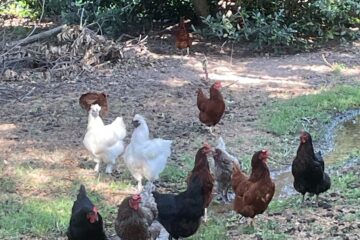
We live on land with room for big trees, open sky, and the kind of edges birds love — fence lines, feeders, a water dish that stays full, chickens that remind everyone the yard is already a living place. Flower Mound sits in that wide Central Flyway corridor: birds that breed farther north, winter farther south, or simply wander along the seasons use skies like ours as a highway with rest stops.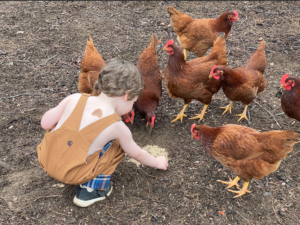
You don’t need a national park to teach a child about migration. You need eyes, ears, and a patch of ground they know well enough to notice when something new shows up. At Calvin’s Farm, the acreage is that patch. Cardinals flash against winter gray. Hummingbirds argue over sugar water in the heat. Flocks of blackbirds pour over the trees like a living weather system. A child who walks the same path every morning learns more than a list of names — they learn change.
Go deep, not wide. One yard, watched for a year, beats a dozen field trips that never return.
Winter — red coats and quiet skies
Winter in North Texas is mild enough that birds stick around if you give them a reason. At our house, that reason is usually seed, suet, and a little patience.
Calvin watches for Northern Cardinals first — that unmistakable red against bare branches, the soft chip call, the way a female’s warm brown still looks like she dressed for the season. Carolina Chickadees and Tufted Titmice work the feeders like tiny engineers, snatching a seed and flying off to hammer it open somewhere safer. White-throated Sparrows or Dark-eyed Juncos (when the cold fronts are generous) scratch under the trees, reminding us that “local” and “visiting” can share the same leaf litter.
Tip for kids: don’t chase the bird with the camera. Hold still under the canopy and let the red find you.
Winter is also when kids learn that stillness is a skill. Cold mornings make noise carry. A quiet child on a porch can hear more than a loud child with fancy gear. Believe your eyes and ears: if the chickadees suddenly go silent, something else may be moving through the canopy — maybe a hawk, maybe just a squirrel. The noticing is the lesson.
Spring — arrival, nest talk, and the first rush of green
Spring is when Flower Mound sounds like it’s trying to say everything at once. Migration picks up. Leaves return. Nesting begins, and the yard fills with argument and song.
Look for Ruby-throated Hummingbirds returning to feeders and flower edges — tiny, fierce, impossible to ignore once you’ve seen one hover. Painted Buntings sometimes flash through North Texas like someone spilled a paint box; even one sighting becomes a story a child retells for weeks. Eastern Bluebirds and Carolina Wrens remind us that cavities, brush, and a little wildness still matter on a small acreage. Mockingbirds rehearse the neighborhood. Mourning doves soft-talk from the wires.
Spring is also when curiosity gets loud. Why that nest there? Why that bird chasing that other bird? Why does the hummingbird prefer this feeder angle? At our house we don’t rush the answers. We write the questions down. Experiment and observe
: change one thing (feeder height, water placement, time of day) and see what changes back.
Summer — heat, water, and the art of the early start
North Texas summer teaches a simple rule: birds wake early, rest hard, and care a lot about water. If you want to watch in July, you go out when the light is still kind — or you sit near a shallow dish and wait.
Hummingbirds keep the drama go
ing. Northern Cardinals and Blue Jays still work the trees. Barn Swallows or Cliff Swallows (depending on your nearby structures) cut the air for insects. At dusk, you might catch the soft shapes of Common Nighthawks over open sky — a reminder that “bird watching” includes the hour after dinner when kids are sticky and happy and still looking up.
Summer birding is also character formation. Heat asks for discipline: water for the birds, shade for the watcher, short sessions that still count. Let the child live — not every observation needs a perfect photo or a Latin name. Sometimes the win is “we saw three kinds of birds before breakfast, and we didn’t argue about it.”
Fall — traffic overhead and the long goodbye
Fall along the Central Flyway feels like the sky has places to be. Some birds leave. Some arrive. Some pass through in numbers that make even a quiet acreage feel connected to Canada and the Gulf in the same week.
Watch for mixed flocks of warblers and other small travelers working the canopy — hard to ID, wonderful to chase with binoculars and a notebook. American Robins gather in bigger groups. Red-winged Blackbirds and grackles can fill a tree like a choir with opinions. Hawks ride the thermals. Geese call from somewhere you can’t see yet. Calvin will stop mid-chore for a V of wings every single time, and honestly, so should we.
Fall is the season that teaches range. Your backyard isn’t the whole story its a station on a longer road. A homeschooled kid who understands that can hold both: deep love of one place, and a sense that Creation is bigger than the fence line.
How to watch (binoculars optional)
You can bird-watch with nothing but a chair and honesty. Gear helps; it isn’t the point.
Quiet first. Voices carry. Soft feet and soft talk turn a yard into a stage where birds keep performing.
A notebook beats a perfect ID. Date, time, weather, what you saw (or thought you saw), what you heard. Sketches count. Wrong guesses count — revise them later. Pride is the enemy; curiosity isn’t.
Binoculars optional — useful when ready. Teach kids to find the bird with naked eyes first, then lift the bins. Otherwise they’ll spend the morning staring at bark.
Feeders and water. Seed for the ground-scratchers and perchers; nectar for hummingbirds in season; a clean, shallow water source year-round. Keep it simple. Clean it. Watch what changes when you change one variable.
Same route, same hour, often. Depth grows from repetition. The child who walks the fence line every morning will spot the stranger bird before the visitor who arrives with a field guide and a checklist.
Homeschool tie-in: observation → notes → curiosity
This is where bird watching becomes Flower Mound homeschool without anyone forcing a unit study.
Start with senses. What did you see? What did you hear? What did the light do? Then write it — a sentence, a list, a drawing with arrows. Then ask one question the child actually cares about: Why do they fight at the feeder? Where do they sleep when it storms? Do the chickens change how the wild birds act?
That’s the Farm pattern: believe your eyes and ears, then go find out. Read a page in a bird book if you want. Look up a call if it helps. Or stay with one bird for a month until the child can predict its habits. Go deep. A season of cardinals taught well will outlast a week of “covering” fifty species.
Soft faith fits here without a speech. The same skies that carry sparrows carry wonder. When a child looks up and gets quiet, something true is happening — attention, gratitude, the sense that the world was made with more detail than any curriculum can invent. We don’t need to lecture that. We need to protect the morning where it can happen.
Come see the birds (and the rest of the farm)
If you’re building a homeschool rhythm that still has room for sky, you’re welcome to ask about a short visit. Calvin’s Farm in Flower Mound is a small acreage classroom — chickens, dirt, questions, and trees big enough to host a year of birds. Tours are simple and outdoor; email calvinsfarm@gmail.com if you’d like to come by.
Our flock keeps growing. Eggs should be back late fall 2026 — until then, the lesson is still the living yard: seasons, feathers, notebooks, and a kid learning to look.
Bird watching all year isn’t about becoming an expert. It’s about becoming someone who notices. On this acreage, that’s enough of a curriculum for a good morning — and sometimes for a whole childhood.
— Calvin’s Farm · Flower Mound, TX · Homeschool farm